What is Kitchen Table Dining?
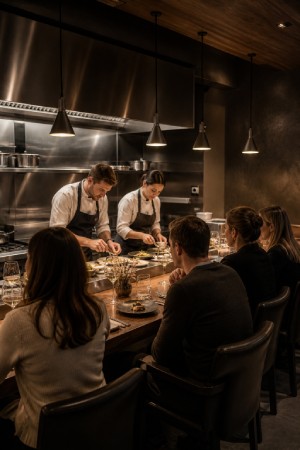
In a kitchen table dining the guests are seated inside or right next to the kitchen, where they can watch the chefs work in real time. They don’t sit in the main dining area like in traditional dinings.
So, what does that entail:
- You sit at a special counter or table positioned within the kitchen.
- You have a direct view of food preparation.
- You watch chefs prepare each dish step by step.
- You often interact directly with the chefs, who may explain techniques, ingredients, or the story behind each course.
- The meal is usually a tasting menu, carefully curated for a small number of guests.
Because of its nature, kitchen table dining is usually very limited in seating, highly personalised and definitely more intimate and engaging than traditional fine dining.
Key Differences from Traditional Dining
Apart from the location and more personalised experience already mentioned, kitchen table dining also differs in how the entire experience is structured and delivered. One key difference is the pace and flow of service. In traditional dining, courses are served in a more standardised manner, but in kitchen table settings, the timing often follows the natural rhythm of the kitchen. So, the experience feels more dynamic and less rigid.
There is also a stronger emphasis on storytelling. Each dish is not just served but often introduced with context. The chef tells you about the inspiration behind it, the sourcing of ingredients, or the technique used.
The level of exclusivity is another major difference. Kitchen table dining usually accommodates only a small number of guests per service. So, it is more limited and harder to access compared to standard restaurant seating.
The History of Chef’s Table and Kitchen Table Experiences
The idea of chef’s table or kitchen table dining began as something informal and exclusive. In many restaurants, chefs would occasionally invite special guests or VIPs into the kitchen as a gesture of hospitality. This was not a standard offering, but rather a privilege reserved for important diners or loyal customers.
These early experiences were often unstructured and spontaneous. Guests would be seated wherever space allowed, simply to observe the kitchen in action. The focus was less on creating a defined experience and more on offering a rare behind-the-scenes look at how meals were prepared.
Over time, this informal concept evolved into a more intentional and structured part of fine dining. Restaurants began to recognise the value of giving guests closer access to the kitchen as a unique dining experience in itself.
As a result, chef’s tables became a planned feature, with designated seating areas, curated tasting menus, and a more organised format. And today, the experience has gained significant popularity in modern fine dining.
Why Michelin-Starred Chefs Offer Kitchen Table Sittings
As already mentioned, Kitchen table dining is now a deliberate part of many top restaurants today. And they’re not just adopting it as a trend. Instead, they are designed to do the following:
- Create a unique guest experience: It allows restaurants to offer something beyond traditional dining by making the process as important as the final dish.
- Showcase culinary craft: It gives chefs the opportunity to highlight their technique, precision, and attention to detail right in front of the guests.
- Build a personal connection: It enables direct interaction between chefs and diners, which creates a more intimate and engaging experience.
- Enhance exclusivity and value: It creates a limited, premium experience with very few seats, which makes it more desirable and often justifies higher pricing.
- Strengthen brand identity: It allows restaurants to express their philosophy and style more directly and gives guests a clearer understanding of what the chef and kitchen represent.
Notable UK Restaurants Offering Kitchen Table Experiences
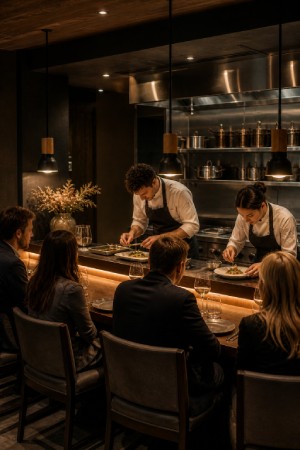
London is the main hub for kitchen table dining in the UK. Here’s a list of some restaurants offering some of the most refined and immersive chef’s table experiences in the city:
- Kitchen Table: A two-Michelin-starred experience where guests sit around a horseshoe-shaped counter. Located at 70 Charlotte Street, London.
- Savoy Grill: Located at 100 Strand, London, this restaurant is owned by Gordon Ramsay.
- Evelyn's Table: An intimate, Michelin-starred 12-seat counter that focuses on seasonal British produce with refined international influences. It’s located at 28 Rupert Street, London.
- Aulis London: This is a development kitchen where chefs’ experiment with new dishes. It’s located at 16A St Anne's Court, London.
While London leads the way, several restaurants across the UK also offer standout kitchen table experiences, including:
- The Three Chimneys and The House Over-by: Located in Colbost, Dunvegan, Isle of Skye, Scotland.
- Cail Bruich: 725 Great Western Rd, Glasgow, Scotland.
- Salt: 8 Church St, Stratford-upon-Avon, England.
- Tallow: 15A Church Rd, Southborough, Tunbridge Wells, Kent.
Where the Kitchen Becomes Part of the Experience
Kitchen table dining takes you through an entirely different kind of fine dining experience, one where you are not just eating the food, but also experiencing how it’s created. We have outlined some top restaurants where you can get this experience in the UK. Feel free to explore.
Friends & Supporters